Blog
How to Plan a Road Trip in UAE: Routes, Car Rental & Tips
November 6, 2026

Learning how to plan a road trip in UAE is mostly about getting the order right: pick your route first, then the car, then the paperwork. The country is small on the map — roughly 160 km from Dubai to Fujairah on the east coast — but it packs mountains, desert, beaches and seven emirates into that space, and the difference between a great trip and a tiring one is usually the plan, not the car.
Short answer: start with one mountain day and one city evening. Drive to Jebel Jais or Hatta early in the morning, come back in the afternoon, and spend the evening on the city loop — Sheikh Zayed Road, Downtown, Marina and Palm Jumeirah. If you have a week, loop all seven emirates. And if the car itself is the point of the trip, the best roads to drive a supercar in Dubai are the same mountain and night-city routes in this guide.
How to plan a road trip in UAE in 7 steps
You do not need a complicated spreadsheet. Work through these seven steps in order and the trip mostly plans itself.
1. Choose your route before anything else
Decide what kind of trip you want: mountains, desert, beaches, or a bit of everything. A first trip usually means one mountain day (Jebel Jais or Hatta), one desert morning (Al Qudra), and one city evening (Sheikh Zayed Road and the Palm). Pick two or three anchor stops per day at most — the driving is easy, but the stops are the trip, and overfilling the day is the most common mistake.
2. Pick your dates around the heat
November to March is the easy window for a UAE road trip, with clear skies and comfortable outdoor stops. October and April still work with early starts. From June to September, plan sunrise departures, long indoor lunch breaks, and sunset arrivals — the roads are fine all year, but the outdoor stops are not.
3. Choose the right car for the route
A standard sedan handles every paved road in this guide, including the Jebel Jais climb and the Hatta highway. You only need a 4×4 for desert driving off the paved roads. If you are renting, match the car to the day: a supercar for the mountain and night-city routes, an SUV if your plan includes desert tracks or a big group with luggage. For a lot of people, renting a premium car in Dubai is the trip itself, and a luxury rental car turns an ordinary drive into the memory.
4. Sort your licence and documents before pickup
Tourists generally need a passport, a visit visa, a home driving licence and a credit card in the driver’s name. Whether you also need an International Driving Permit depends on your licence country — some licences are accepted without one, others are not — so check the listing for your licence country before you book. Residents need an Emirates ID and a UAE licence. Keep the rental agreement and the support number saved in your phone before you leave the city.
5. Plan fuel, tolls and parking
Fill up before any mountain or desert stretch — there is no fuel station on the Jebel Jais climb itself. Salik tolls in Dubai and parking charges are the renter’s responsibility on a rental car and are usually settled through the rental company after the trip, often with an admin fee. In the cities, plan your parking before you arrive at the stop; the popular viewpoints and beach areas fill up on winter weekends.
6. Pack smart for the desert and the mountains
Water, snacks, sunscreen, a first-aid kit, a phone charger and offline maps cover most of what a UAE road trip needs. Add a light jacket for the mountains — Jebel Jais is noticeably cooler than Dubai — and a flashlight if you plan a sunrise or night stop. For desert trips, a car recovery kit is worth having, and a spare tyre check before you leave is never wasted.
7. Book your stays around the route, not the other way round
Book one base per day at most and keep the driving to roughly two to three hours a day, apart from the mountain days. A single hotel move per day keeps the trip relaxed; moving every night turns it into a packing exercise. In peak season, from November to March, book the mountain and desert stays in advance — the good ones fill up first.
Best time for a UAE road trip
The best time for a road trip in UAE is November to March, when daytime temperatures are comfortable for outdoor stops and the mountain roads are at their best. Mornings are the quietest time on the popular routes — leave Dubai early for Jebel Jais or Hatta and you will have the road mostly to yourself. Evenings suit the city: the skyline routes are best after the rush hour has eased and the towers are lit. Summer trips still work, but they are dawn-and-dusk trips, not midday ones.
The best road trip routes in UAE
These are the routes that carry the trip. They are the same roads the supercar guides list, because the best roads to drive in Dubai are the best roads to drive in the UAE full stop — mountains, coast and desert, all within a few hours of each other.
Jebel Jais: the mountain climb
The Jebel Jais road trip is the headline drive in the UAE. Jebel Jais is the country’s highest peak at 1,934 metres, and the road up it climbs in long sweeping curves and tight hairpins, with the view of the Hajar Mountains changing at almost every bend. It takes about 2–2.5 hours each way from Dubai, roughly 175 km, so treat it as a full day, not a morning trip.
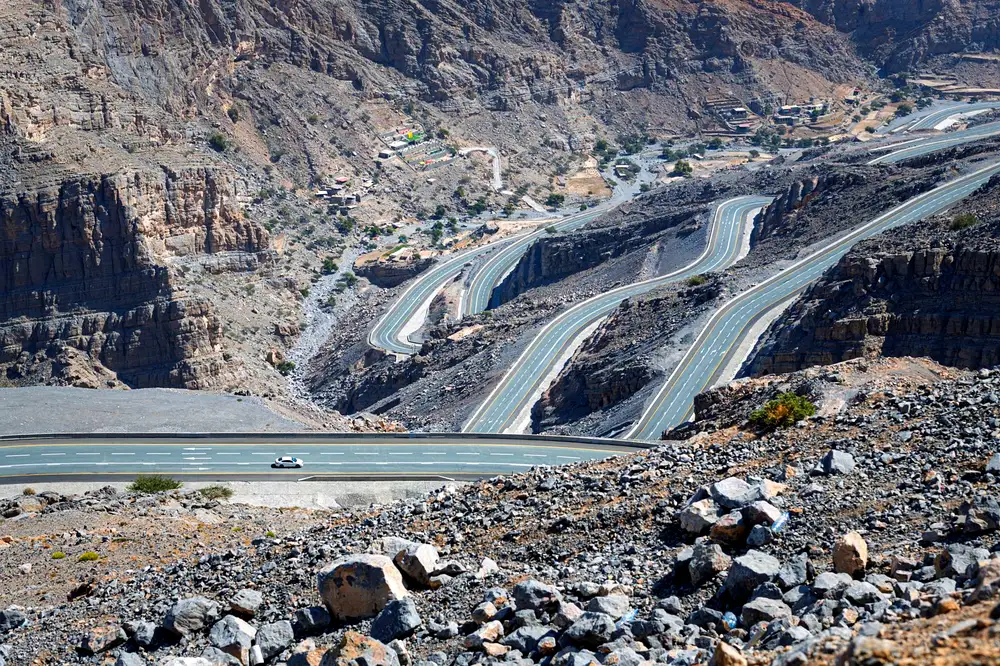
One thing to get right before you go: you cannot drive to the summit. The public road ends near the viewing decks and the zipline area. The viewing deck park sits at 1,250 metres and the 1484 by Puro restaurant at 1,484 metres, both just shy of the summit, and the true 1,934-metre summit is on the Omani side. A small entry fee applies at the viewing deck park, so check the current fee and the current access rules before you set out — the mountain’s access rules changed in 2026. Fill up before the ascent, expect slow traffic around the viewpoints on winter weekends, and drive it as a scenic road, not a race track.
Hatta: mountains, dam and heritage village
Hatta is Dubai’s mountain exclave in the Hajar Mountains, near the Oman border, roughly 130 km from central Dubai. The drive takes you out of the city on the highway — Al Ain–Dubai Road (E66), then Dubai–Hatta Road (E44) — and into rocky terrain, and the roads around Hatta itself are quiet.
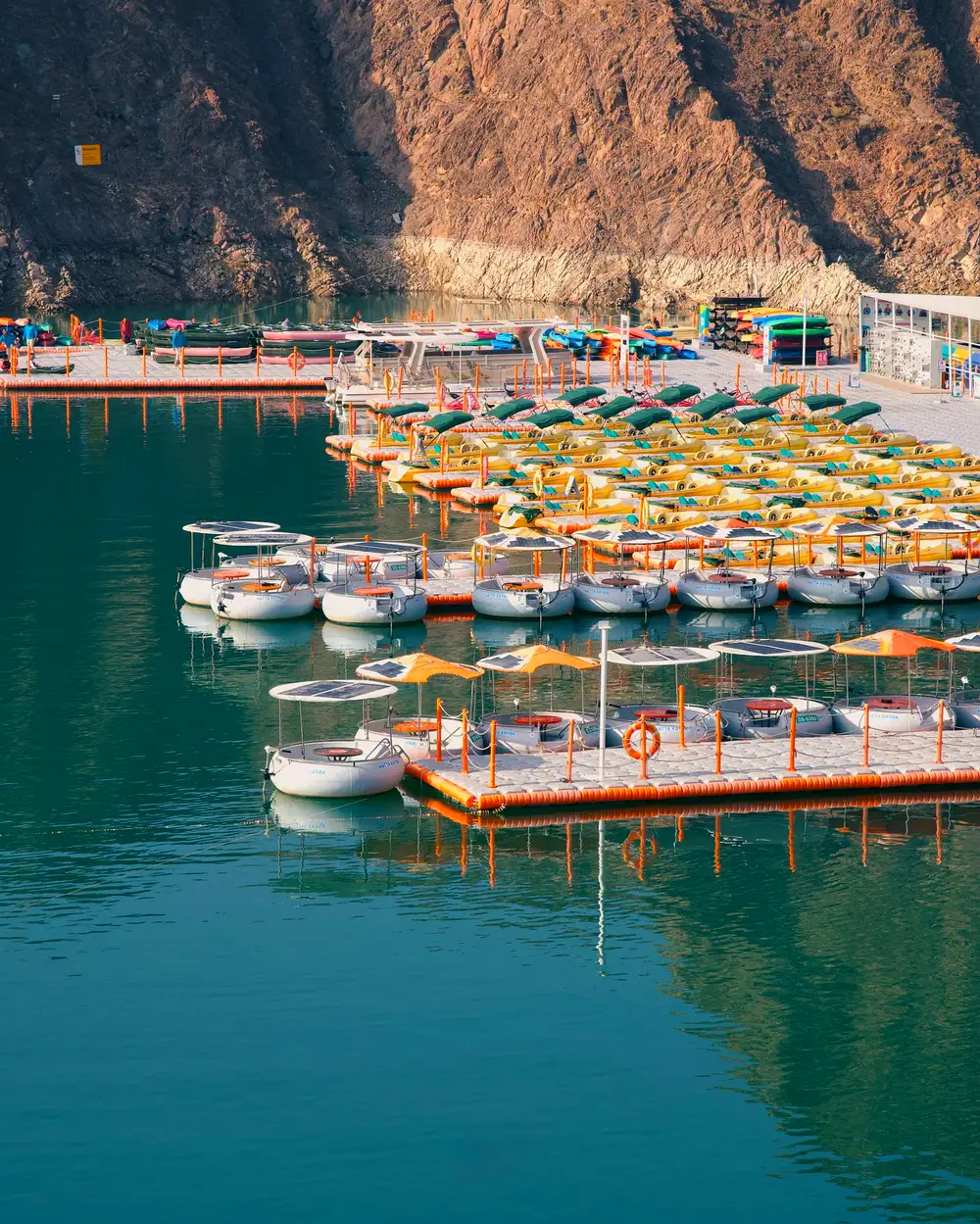
Stop first at Hatta Dam, where turquoise water sits between bare mountains, and kayaks and pedal boats operate on the reservoir. Then visit the Hatta Heritage Village, a restored heritage site with traditional houses, watchtowers, a fort and a mosque. Check your navigation route and your rental agreement before you leave: some routes to Hatta run close to Omani territory, and cross-border driving usually needs the rental company’s permission in advance.
Sheikh Zayed Road at night: the skyline drive
Sheikh Zayed Road is not about speed. It runs through the Downtown skyline area, directly past the Museum of the Future, with the Burj Khalifa nearby in Downtown, and driving it late in the evening when the towers are lit is the most photographed stretch of road in the country. At rush hour it is a traffic jam with a nice view, so go late in the evening or early on a weekend morning, and remember that speed cameras and radars enforce limits along the road. If you would rather not drive it at peak hours at all, check the Dubai Metro timings and ride the same corridor instead.
Palm Jumeirah, Marina and JBR: the photo loop
The Palm Jumeirah drive is short, slow and entirely about the photos: down the trunk of the Palm to the crescent, with Atlantis, The Palm at the far end and the Marina skyline behind you on the way back. Pair it with the photo loop — Dubai Marina Walk, JBR Beach and The Walk, then Downtown and Mohammed Bin Rashid Boulevard with the Burj Khalifa behind you.

Keep the loop short and do it in the evening, when the fountains and the tower lighting are on. Every one of these areas is congested at peak times, and the point is the backdrop, not the mileage.
Al Qudra Road at sunrise: desert and lakes
Al Qudra Road runs out into the desert south-west of the city, and the draw is what sits beside it: the Al Qudra Lakes, the desert sunrise, and the 86 km Al Qudra Cycling Track through the Al Marmoom Desert Conservation Reserve. The cycling track is for bicycles, not cars — nobody drives a car on it. Drive Al Qudra Road, park at the lakes area, and watch the sunrise from there. It is a quiet, early-morning stop that fits before a Jebel Jais or Hatta day, and it is at its best from October to April.
A road trip plan that works: 2 days, or 7 days
Pick the length that fits your trip. Both plans below use the routes above, so nothing here needs a new booking — just the order.
The 2-day plan
Day one is the city, at night. Pick the car up in the late afternoon, drive Sheikh Zayed Road once the evening rush has eased, loop through Downtown, then take the Marina and JBR stretch and finish on Palm Jumeirah toward Atlantis. Day two is the mountains, early. Leave Dubai before the heat builds, climb Jebel Jais, spend an hour or two at the viewing decks, have lunch on the mountain or on the way back, and return in the afternoon. If you have a third day, use it for Hatta and Al Qudra at sunrise.
The 7-day loop: all seven emirates
One highlight per emirate per day, with one hotel move a day at most. Day 1, Dubai: arrival and Old Dubai. Day 2, Sharjah and Ajman: museums, the Arts Area and the Ajman corniche (roughly 30–50 minutes from Dubai). Day 3, Umm Al Quwain and Ras Al Khaimah: quiet coast, then Jebel Jais (roughly 60–90 minutes from Sharjah). Day 4, Fujairah: east-coast beaches and forts (roughly 3–4 hours from RAK). Day 5, Abu Dhabi: Sheikh Zayed Grand Mosque and the Corniche — see the Abu Dhabi City Tour for the full route (roughly 3–4 hours from Fujairah). Day 6, Al Ain: the oasis, Al Jahili Fort and the Jebel Hafeet drive. Day 7, back to Dubai (roughly 45–75 minutes from Abu Dhabi). All drive times here are rough — check live navigation on the day, and accept that the smaller emirates get hours, not days, on a one-week loop.
Before you rent a car in UAE
The roads above are only half the trip. The other half is the rental agreement, and the details that catch people out are almost always the same ones. Age and driving-experience requirements depend on the rental company, so check them in the conditions of the offer before you book. The same goes for deposits, insurance and mileage — no two companies handle them the same way.
Who can rent, and what documents do you need?
You will usually need your passport and driving licence, plus an International Driving Permit for some nationalities. Tourists generally need a passport, a visit visa, a home licence and a credit card in the driver’s name. The minimum age is usually 21, but many firms ask for 25 for supercars and high-performance models, and some ask for a few years of driving experience on top.
Renting a Ferrari in Dubai
For a lot of people, the dream car wears a prancing horse badge. If that is you, you can rent a Ferrari in Dubai and compare offers from different rental companies before you settle on the model and dates. Ferraris are listed by the same rental marketplaces as other supercars, and the same rules apply: check the age requirement for the specific model, the mileage allowance and the deposit before you book, because all three can differ between a Ferrari and the next car on the same page. If a Ferrari is not your car, the same market covers everything from a Rolls-Royce to a Lamborghini, so compare the whole shortlist rather than booking the first name you recognise.
Deposits and insurance: read the excess, not just the headline
High-performance cars tend to have stricter conditions than everyday cars, but the range is wide. Some rental partners list sports cars with no deposit at all, while other firms require a large refundable hold and a higher insurance excess. Basic insurance is usually included, with optional fuller cover on top. Read what the insurance covers and what the excess is — that is the number that matters if anything goes wrong — and check how long a deposit hold lasts after you return the car, since tolls and fines can be settled from it.
Is there a mileage limit?
Many rentals include a daily limit. The standard allowance on supercar listings is typically 200–250 km per day, with a charge for extra kilometres. A round trip to Jebel Jais covers roughly 350 km, so check the limit before you plan the route — a mountain day can use up more than a day’s allowance, and the excess charge depends on your listing. The city loop and the Palm are short by comparison and will not trouble any normal allowance.
What about tolls and fines?
Salik charges and any traffic fines go to the renter, and a supercar gets no special treatment from the speed cameras. Tolls are usually settled through the rental company after the trip, often with an admin fee per charge, and fines can be deducted from your deposit or card. Keep the two separate in your head: Salik is a road-use toll, a fine is a penalty, and both are your responsibility under the rental agreement.
What if something goes wrong mid-trip?
It helps to book through a service you can reach at any hour. On Yango Drive, support works 24/7, which is reassuring when you are a couple of hours from the city in a car worth more than most apartments. Save the support number and the roadside assistance details in your phone before you leave Dubai, and check whether your rental includes breakdown cover for the mountain roads, not just the city.
What to pack, and what a UAE road trip costs
Pack for two climates in one day: city heat and mountain cool. Water, snacks, sunscreen, a first-aid kit, a phone charger and offline maps are the essentials, plus a light jacket for Jebel Jais and a flashlight for sunrise or night stops. On costs, fuel is the smallest part of a UAE road trip — the bigger costs are the car and the stays. Rental rates vary sharply by model, season and length, so there is no single figure worth quoting; entry-level cars cost far less per day than a flagship Ferrari or Lamborghini, and longer rentals usually work out cheaper per day. Tolls and any fines are extra, and they are charged to the renter. Set the budget by the car and the hotels first, and the rest of the trip will take care of itself.
FAQs
How many days do I need for a road trip in UAE?
Two days cover the essentials: one mountain day (Jebel Jais or Hatta) and one city evening (Sheikh Zayed Road, Marina and Palm Jumeirah). A week covers all seven emirates as a highlights loop, with roughly two to three hours of driving a day apart from the mountain days.
What is the best time for a road trip in UAE?
November to March is the best window, with comfortable daytime temperatures for outdoor stops. Leave early in the morning for the mountain routes, and drive the city routes in the late evening. Summer trips work too, but plan them around dawn and dusk.
Can tourists drive and rent a car in UAE?
Yes. Tourists can drive and rent a car in the UAE with a passport, a visit visa, a home driving licence and a credit card in the driver’s name. You may also need an International Driving Permit, depending on your licence country — check the listing for your nationality before you book.
Do I need a 4×4 for a UAE road trip?
No, not for the paved routes in this guide — a standard sedan handles Jebel Jais, Hatta, the city roads and Al Qudra Road. You only need a 4×4 for desert driving off the paved roads. A supercar is fine on every paved road here, as long as you obey the limits.
Do I need an International Driving Permit to drive in Dubai as a tourist?
It depends on your licence country. Some licences are accepted without an IDP, others are not. Check the listing for your licence country, and carry the IDP with your home licence if one is required for you.
Is there a mileage limit on rental cars in Dubai?
Many rentals include a daily mileage limit, typically 200–250 km per day on supercar listings, with a charge for extra kilometres. A Dubai to Jebel Jais return is roughly 350 km, so check the allowance on your listing before planning a mountain day.
How does Salik work for rental cars in Dubai?
Salik tolls are charged to the renter and are usually settled through the rental company after the trip, often with an admin fee. Traffic fines are separate and are also the renter’s responsibility. Check how your rental company bills tolls before you drive.
How far is Jebel Jais from Dubai?
About 2–2.5 hours each way by car, roughly 175 km from Dubai depending on your starting point and traffic. The mountain climb itself is the last stretch of the drive, and the public road ends near the viewing decks.

Hi! We’re the Travel Blog Dubai Team — passionate travelers who explore Dubai every day to bring you honest tips, best places to visit, budget ideas, and real experiences.Whether you’re planning your first trip or you live in the UAE, our guides help you discover the best of Dubai, hassle-free.